Simple Steps
Responsible 100 runs on stories, which is why we enable and incentivise their creation and dissemination.
The more stories that a participating business or organisation creates and shares, the greater it benefits itself, other participants, our partner organisations and the Responsible 100 initiative as a whole.
This stated, as a participating organisation, you have complete control over whether you share your stories, which ones, and with whom. What and when you share is completely up to you. If you choose to share nothing, you will still benefit from our supported steps and process.
Step 1: Determine Which Issues Are Highest Priority
No single responsibility issue impacts any two businesses in the same way. We offer a 5 minute exercise, for free, that enables you to prioritise which responsibility issues are most important to your business, in your personal opinion.
This is our starting point. Upon completion, each respondent sees their selections in relation to those of others and has the opportunity to revise their initial choices should they wish.
Results and analysis are shared with you instantly upon completion. This serves as an excellent window on how we work, and how we can help you and your organisation.
|
Issues prioritised by |
Issues prioritised by |
Results discussed with Responsible 100 |
Stories drafted |
|---|---|---|---|
|
✔ |
Step 2: Invite Your Colleagues
After you’ve had a look around our tool, invite others from your organisation to join you by also taking the prioritisation exercise. Results remain private and confidential to each respondent unless and until Responsible 100 is satisfied: 1. you all work at the same organisation; and 2. you all consent to sharing your priorities with your colleagues.
Once colleagues have consented, we can create an aggregate view of priority issues from people across your organisation. From there, we can work towards an agreed set of priorities. This really requires a brief discussion…
|
Issues prioritised by |
Issues prioritised by |
Results discussed with Responsible 100 |
Stories drafted |
|---|---|---|---|
|
✔ |
✔ |
✔ |
Step 3: Talk With Us About A Key Responsibility Issue
Once the right people in your organisation have undertaken the prioritisation exercise, or at least have been invited to do so, we’ll arrange a time to talk. For our first group call, simply choose a high priority responsibility issue, or maybe two, that you would like to focus on.
Together, for your chosen issue, we’ll estimate how well you currently respond or perform, using a straightforward four point scale. Our benchmarks describe and loosely define performance as either Poor, Okay, Good or Excellent.
In the course of our initial discussion you’ll get to explain how your organisation currently responds to or approaches the selected issue. We’ll jointly determine whether your performance is currently Poor, Okay, Good or Excellent, and we’ll capture the key information you share and turn this into a written account using plain and simple language. This will form the draft of your first story.
With this done, the logic, power and simplicity of this approach will be crystal clear.
|
Issues prioritised by |
Issues prioritised by |
Results discussed with Responsible 100 |
Stories drafted |
|---|---|---|---|
|
✔ |
✔ |
✔ |
✔ |
Step 4: Complete Your Dashboard And Discover Where And How To Improve
In these crazy times it’s never been more obvious: no one has all the answers.
Responsible 100 isn’t a place for your AI-derived marketing babble or polished brochure copy. It’s a place where organisations that tell the truth and try their best are able to usefully share what is currently working for them, and what is not, for mutual benefit.
By sharing your experiences, challenges, and successes, you help us collectively refine and improve our shared understanding of business responsibility, and of what can conceivably be achieved, and you encourage others to share their stories too.
Your dashboard will soon become a mine of valuable data and a map to plot your overall improvement. It is a tool for internal and external reporting, for defining strategies and for measuring your progress.
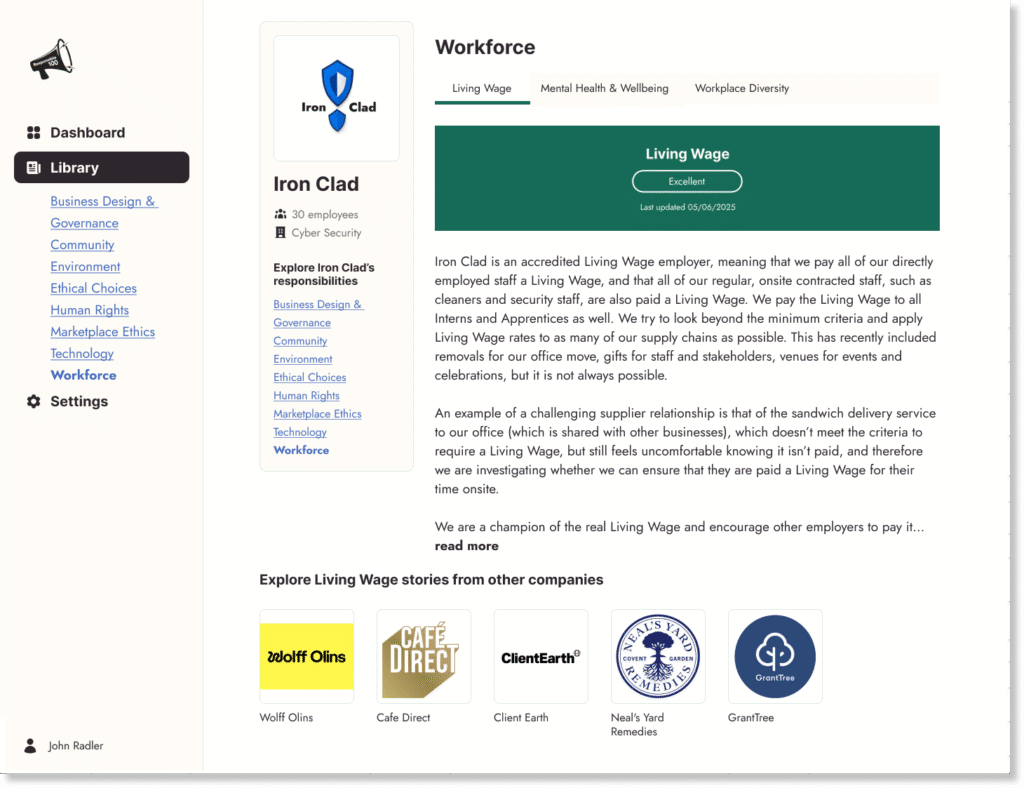
You’ll have the option to share your stories in our digital library and explore those that other participant companies have shared. Our library is a collection of stories and resources from the community of other businesses and expert partner organisations. Participants lend to and borrow from it, providing know how and inspiration for others to identify ways to improve, from small wins to more transformational undertakings.
As your policies and practices change to reflect your current priorities and performances, so will your stories. This keeps the library constantly evolving, allowing for continuous learning, contributions, and commitment to responsible business. (NB the example companies used in the screengrab below may be previous Responsible 100 participants or dummy organisations.)